
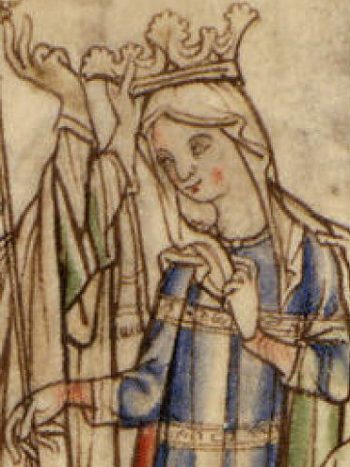
Edith of Wessex is an important figure in 1066 history. She was the daughter of Earl Godwin of Wessex, the most powerful magnate in England, and became the wife of King Edward the Confessor. After her husband’s death in January 1066, her brother Harold became King until he was defeated by William of Normandy in October 1066.
Early Life
Edith of Wessex was born around 1025 to Earl Godwin of Wessex and his wife, Gytha Thorkelsdóttir. Godwin was born around 1001, during the reign of Aethelred the Unready but had risen to become chief advisor to King Canute who took the throne in 1016. By the time of Edith’s birth Earl Godwin was one of the most powerful men in England.
Unlike most female children, Edith received a very good education. She was schooled in Latin, classical literature and Christian teachings as well as more traditional female pursuits such as sewing and household management.
After Canute’s death in 1035, England was ruled by his two sons, both of whom died without issue. In 1042, the Crown reverted to the Anglo-Saxon line and Aethelred the Unready’s son Edward became King.
Queen of England
King Edward , known to history as King Edward the Confessor, was born around 1003. When Canute became King in 1016, Edward was sent to his mother’s relatives in Normandy for safety. When he returned as King 26 years later, he was seen as more Norman than English and needed the support of the nobility to rule, particularly Earl Godwin.
In 1045 Edward married Earl Godwin’s daughter Edith. Edward may have chosen to marry Edith to secure Godwin’s support or Godwin may have made it a condition of his support. Edith’s brother’s were also given prominent roles.

Edith was a much loved and influential queen. She was noted for her piety, patronage of the Church, and cultural refinement. She became a patron of the arts and of learning, and she supported the development of Westminster Abbey, Edward’s great ecclesiastical project. However, the marriage was marred by the lack of children.
Historians are divided as the reasons for the couple’s childlessness. Medieval historians such as William of Malmesbury, claimed that Edward and Edith lived as if celibate due to Edward’s religious piety. Another theory is that Edward chose not to consummate the marriage to prevent a Godwin from becoming King. However, it is also likely that the couple were unable to have children.
In 1051, the Godwin family fell out with the king and were exiled. Edith was not exiled but was sent away from court and confined to a nunnery at Wilton Abbey. Some commentators have seen this as a possible move towards having the marriage annulled so he could remarry. However, when Godwin and his sons returned in triumph in 1052, Edward had no choice but to restore the family to their former positions and Edith returned to court as queen.
From then on, Edith remained securely at Edward’s side. She supported her husband with his project to construct a new Minster to the west of London on the site of an old Benedictine monastery. This building, known as Westminster Abbey was consecrated a week before Edward’s death in January 1066. Edith’s household became a place of influence, and she offered her patronage to various religious institutions as well as leading chroniclers such as the monk Florence of Worcester.
Final Years and the Norman Conquest
When Edward the Confessor died in January 1066, Edith oversaw his funeral and the completion of Westminster Abbey. Her brother Harold was crowned king immediately after Edward’s death, but his reign was short-lived, ending with his defeat and death at the Battle of Hastings in October 1066.
Following William the Conqueror’s victory, Edith managed to survive politically. William treated her with respect, likely recognising her as the widow of Edward and a figure of religious reputation. She commissioned the Vita Ædwardi Regis (“Life of King Edward”), which is an important source not only for Edward’s reign but also for Edith herself. It portrays her as a queen of great learning, piety. She retained her lands and lived quietly, mainly at Winchester.
Edith of Wessex died on 18th December 1075 and was buried alongside her husband Edward at Westminster Abbey.